Can You Get Pregnant with One Fallopian Tube Blocked? Having a blocked fallopian tube can naturally cause concern for women who are trying to conceive. One of the most common questions fertility specialists hear is:
“If one of my fallopian tubes is blocked, can I still get pregnant?”
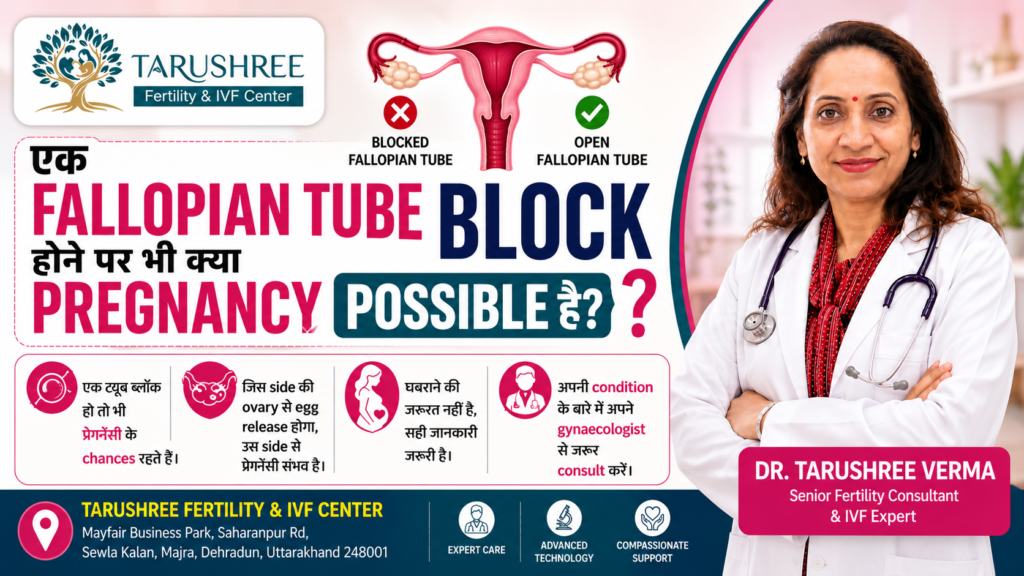
The answer is yes, pregnancy may still be possible if one fallopian tube is blocked and the other tube is open and healthy. However, the chances of natural conception depend on several factors, including the condition of the open tube, ovulation, ovarian reserve, age, sperm health, and the presence of other fertility problems.
At Tarushree Fertility & IVF Center, we believe that understanding your fertility condition is the first step toward making the right treatment decision.
What Are Fallopian Tubes?
Fallopian tubes are two narrow tubes that connect the ovaries to the uterus. They play an important role in natural conception.
Normally, when an egg is released from an ovary during ovulation, it is picked up by the nearby fallopian tube. Fertilization usually takes place inside the fallopian tube when sperm meets the egg. The resulting embryo then travels toward the uterus, where implantation can occur.
For this reason, healthy and functioning fallopian tubes are important for natural conception.
View On Instagram : https://www.instagram.com/reel/Dcc9DZyS6Je/
Can You Get Pregnant If One Fallopian Tube Is Blocked?
Yes, it is possible.
If one fallopian tube is blocked but the other fallopian tube is open and functioning properly, natural pregnancy may still occur.
For example, if the egg is released from the ovary on the side of the open tube and the tube is healthy, sperm and egg may meet and fertilization may occur naturally.
However, fertility is more complex than simply knowing whether one tube is open or blocked. The overall fertility picture needs to be evaluated before estimating an individual’s chances of pregnancy.
According to the American Society for Reproductive Medicine (ASRM), the treatment approach for tubal-factor infertility depends on factors such as age, ovarian reserve, the location and extent of tubal disease, sperm parameters, other infertility factors, and the patient’s preferences.

Does One Blocked Tube Mean You Cannot Become a Mother?
No.
Having one blocked fallopian tube does not automatically mean that pregnancy is impossible.
If the other tube is open and healthy, pregnancy may still occur naturally. However, the chances may vary from person to person.
It is also important to understand that the ovaries and fallopian tubes do not always function in a simple “left ovary = left tube, right ovary = right tube” pattern. Therefore, it is better not to assume that pregnancy is possible or impossible based only on which side is blocked.
A fertility specialist can assess your individual situation and explain the most appropriate options.
What Happens If the Open Fallopian Tube Is Healthy?
When one tube is blocked and the other is open, several factors become important:
- Whether the open tube is completely patent
- Whether the tube is structurally healthy
- Whether ovulation is occurring regularly
- Ovarian reserve and egg quality
- Age of the woman
- Sperm count, motility and morphology
- Presence of endometriosis or pelvic adhesions
- Previous pelvic infections or surgeries
- Duration of infertility
If these factors are favourable, natural conception may be possible.
What Causes Fallopian Tube Blockage?
Fallopian tube blockage can occur for several reasons. Some common causes include:
1. Pelvic Infections
Certain pelvic infections can cause inflammation and scarring around the fallopian tubes. Previous infections may sometimes damage the tubes even when symptoms were not severe.
2. Pelvic Inflammatory Disease
Pelvic inflammatory disease can cause inflammation and adhesions that interfere with normal tubal function.
3. Endometriosis
Endometriosis can affect the pelvic organs and may lead to inflammation, adhesions and changes around the fallopian tubes.
4. Previous Pelvic or Abdominal Surgery
Certain surgeries can result in scar tissue or adhesions around the reproductive organs, potentially affecting the fallopian tubes.
5. Previous Ectopic Pregnancy
A previous ectopic pregnancy involving a fallopian tube may damage the tube.
6. Hydrosalpinx
Hydrosalpinx occurs when a fallopian tube becomes blocked and fills with fluid. This condition can be particularly important when planning fertility treatment.
Tubal disease is a recognised cause of female-factor infertility, and ASRM notes that tubal disease accounts for a substantial proportion of female-factor infertility cases.
How Is a Blocked Fallopian Tube Diagnosed?
A woman may have a blocked fallopian tube without experiencing any obvious symptoms.
Therefore, proper fertility evaluation is important.
Hysterosalpingography (HSG)
An HSG is an imaging test commonly used to evaluate whether the fallopian tubes are open.
During the procedure, contrast material is introduced through the uterus while imaging is performed to observe whether the contrast passes through the fallopian tubes.
ASRM considers HSG an important first-line method for evaluating tubal patency, although findings suggesting blockage—particularly proximal blockage—may sometimes require further assessment because false-positive results can occur.
Sonohysterography / Contrast Ultrasound
Certain ultrasound-based procedures can also help evaluate tubal patency. The exact test recommended depends on the patient’s medical history and the fertility specialist’s assessment.
Laparoscopy
In selected cases, laparoscopy may be recommended to evaluate the pelvis and fallopian tubes more directly, particularly when other pelvic conditions are suspected or when surgery is already being considered.
Can a Blocked Fallopian Tube Be Treated?
Treatment depends on where the blockage is located, how severe it is, whether the tube is damaged, the woman’s age, ovarian reserve, and other fertility factors.
In selected patients, tubal procedures may be considered. For example, proximal tubal obstruction may sometimes be treated with tubal cannulation.
However, tubal surgery is not appropriate for everyone. In some situations, IVF may be a more suitable treatment option.
ASRM recommends considering multiple factors—including age, ovarian reserve, extent of tubal disease, sperm quality, other infertility factors, ectopic pregnancy risk and patient preference—when deciding between tubal surgery and IVF.
When Is IVF Considered for Blocked Fallopian Tubes?
IVF (In Vitro Fertilization) can be an important treatment option when tubal blockage significantly affects the chances of natural conception.
During IVF:
- Eggs are collected from the ovaries.
- The eggs are fertilized with sperm in the laboratory.
- Embryos are developed under controlled laboratory conditions.
- A suitable embryo is transferred into the uterus.
Because IVF does not require the egg and sperm to meet inside the fallopian tube, it can bypass certain types of tubal-factor infertility.
IVF may be considered particularly when there is significant tubal damage, bilateral tubal blockage, certain forms of hydrosalpinx, additional infertility factors, or when previous treatments have not been successful. The appropriate treatment should always be individualised.
One Tube Blocked vs Both Tubes Blocked
The fertility situation can be different depending on whether one or both tubes are affected.
One Fallopian Tube Blocked
If one tube is blocked and the other is open and healthy, natural pregnancy may still be possible.
The chances depend on factors such as ovulation, age, ovarian reserve, sperm health and the condition of the open tube.
Both Fallopian Tubes Blocked
When both tubes are completely blocked, natural fertilization becomes much more difficult because the egg and sperm cannot normally meet through the fallopian tubes.
In such cases, fertility treatment such as IVF may be considered depending on the individual situation.
Does a Blocked Fallopian Tube Cause Infertility?
A blocked fallopian tube can contribute to infertility, but it does not always mean that a woman cannot conceive.
Infertility is usually evaluated by looking at the complete reproductive picture, rather than focusing on one test result alone.
A proper fertility evaluation may include assessment of:
- Ovulation
- Ovarian reserve
- Uterus and pelvic anatomy
- Fallopian tube patency
- Endometriosis or other pelvic conditions
- Male partner’s semen analysis
- Medical and reproductive history
ASRM recommends evaluating both partners when applicable because male-factor infertility can also contribute to difficulty conceiving.
How Age Can Affect Pregnancy Chances
Age is another important factor when evaluating fertility.
Female fertility generally declines with increasing age, particularly because egg quantity and quality decrease over time.
Therefore, a woman with one blocked tube may have a very different fertility outlook from another woman with the same tubal finding but a different age, ovarian reserve or reproductive history.
This is why fertility treatment should be personalised rather than based only on whether one tube is blocked.
When Should You See a Fertility Specialist?
You should consider consulting a fertility specialist if:
- You already know that one or both fallopian tubes are blocked.
- You have been trying to conceive without success.
- You have a history of pelvic infection.
- You have had previous pelvic or abdominal surgery.
- You have endometriosis.
- You have experienced an ectopic pregnancy.
- You have irregular ovulation or menstrual cycles.
- Your partner has an abnormal semen analysis.
- You are concerned about declining fertility due to age.
ASRM recommends infertility evaluation after 12 months of regular, unprotected intercourse in women younger than 35, after 6 months in women aged 35 or older, and more immediate evaluation may be appropriate for women over 40 or when a known fertility-related condition is present.
Can You Get Pregnant Naturally With One Blocked Tube?
The simple answer is:
Yes, natural pregnancy may be possible with one blocked fallopian tube if the other tube is open and healthy.
But it is important not to assume that pregnancy will definitely occur.
Your chances depend on the complete fertility profile, including:
Age + Ovulation + Ovarian Reserve + Open Tube + Sperm Health + Uterine Health + Other Fertility Factors
A fertility specialist can help identify which factors may be affecting your chances and whether natural conception, medication, IUI, tubal treatment or IVF may be appropriate.
Frequently Asked Questions
1. Can I get pregnant with one blocked fallopian tube?
Yes. If the other fallopian tube is open and functioning properly, natural pregnancy may still be possible. However, individual chances vary.
2. Does one blocked tube mean I need IVF?
Not necessarily. IVF is not automatically required simply because one tube is blocked. Treatment depends on your age, ovarian reserve, ovulation, the condition of the other tube, sperm parameters and other fertility factors.
3. Can a blocked fallopian tube be opened?
In selected cases, certain tubal procedures may be possible. However, not every blocked or damaged tube is suitable for treatment. A fertility specialist needs to assess the location and severity of the blockage.
4. What test checks whether my fallopian tubes are open?
HSG is commonly used to assess tubal patency. Other tests, including contrast ultrasound-based procedures or laparoscopy in selected cases, may also be used depending on the clinical situation.
5. Is pregnancy possible if both tubes are blocked?
Natural conception is generally not possible when both fallopian tubes are completely blocked because the egg and sperm cannot normally meet through the tubes. IVF may be considered in such situations.
6. Does a blocked tube increase ectopic pregnancy risk?
Damaged fallopian tubes can be associated with an increased risk of ectopic pregnancy. An ectopic pregnancy occurs when a fertilised egg implants outside the uterus, most commonly in a fallopian tube.
If you become pregnant after having known tubal disease, early medical assessment is important.
Final Takeaway
One blocked fallopian tube does not automatically mean that you cannot become a mother.
If the other tube is open and healthy, natural pregnancy may still be possible. However, fertility depends on many factors, and the condition of the fallopian tubes should be evaluated as part of a complete fertility assessment.
If you have been diagnosed with a blocked fallopian tube, do not panic or make treatment decisions based on the blockage alone.
Consult a qualified gynaecologist or fertility specialist to understand your individual fertility potential and the treatment options available to you.
About Tarushree Fertility & IVF Center
Tarushree Fertility & IVF Center is dedicated to providing personalised fertility evaluation and treatment options for individuals and couples planning a family.
Our fertility team can help evaluate conditions such as tubal-factor infertility and guide patients regarding appropriate fertility treatment based on their individual medical history and reproductive goals.
Hospital Address:
Mayfair Business Park, Saharanpur Rd,
Sewla Kalan, Majra,
Dehradun, Uttarakhand – 248001
Book a fertility consultation with Tarushree Fertility & IVF Center to understand your fertility options.
Medical Disclaimer
This article is intended for general educational and awareness purposes only. It does not replace a medical consultation, diagnosis or personalised treatment plan. Fertility and pregnancy outcomes vary from person to person. If you have a blocked fallopian tube or are experiencing difficulty conceiving, consult a qualified gynaecologist or fertility specialist for appropriate evaluation and treatment.